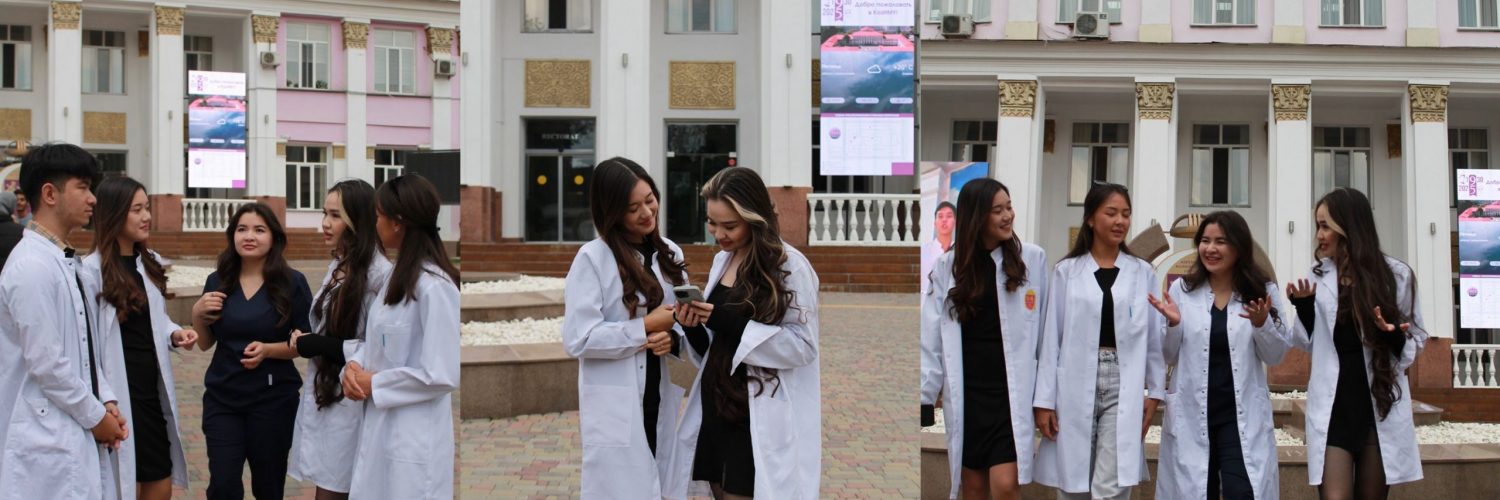
The Department of Biostatistics and Foundations of Scientific Research was established by order No. 3494l on September 16, 2015. The first head of the department was Baurzhan Sabitovich Zhusupov (2015-2017).
Since December 2017, Aizat Shalkharovna Aymakhanova has been leading the department.

The department’s team actively implements innovative teaching technologies and interactive methods into the educational process. They have more than 15 acts of implementing innovative teaching methods.
The department is actively involved in a wide range of research initiatives supported at the intra-university, national, and inter-institutional levels. The scientific work carried out by the faculty contributes to the development of both fundamental and applied fields, strengthening interdisciplinary collaboration and advancing academic excellence.
One of the department’s major initiatives is the internal university grant of KazNMU titled “The Interrelation between Students’ Academic Performance, Psychological Well-Being, and Self-Esteem.” This project is implemented by the department’s teaching staff and focuses on identifying factors that influence students’ academic success and psychological well-being, while developing evidence-based approaches to improving the educational environment.
The department also takes part in the national research project funded by the Ministry of Science and Higher Education of the Republic of Kazakhstan (MSHE RK) entitled “Research of a Certain Class of Integral Operators and Their Applications,” conducted at L.N. Gumilyov Eurasian National University. This project addresses fundamental mathematical problems and expands the possibilities of applying integral operators in various scientific fields.
In addition, faculty members contribute to another MSHE RK–funded project, “Scientific Justification for Improving the Prevention of HIV Infection Spread Among Users of New Psychoactive Substances in Kazakhstan.” The study is carried out in collaboration with the Kazakh Scientific Center of Dermatology and Infectious Diseases of the Ministry of Health and focuses on developing effective prevention strategies for vulnerable populations.
The department is also engaged in an inter-university collaborative project with Al-Farabi Kazakh National University titled “Reducing Socio-Economic Inequality in Kazakhstan’s Regions through Investment in Health and Improved Healthcare System Organization.” This research examines how investments in healthcare can reduce regional socio-economic disparities and promote more effective health system management.
Participation in these projects enhances the department’s scientific capacity, promotes modern research approaches, and strengthens its academic presence at both national and international levels.
